

Ep. 4
47:48 min
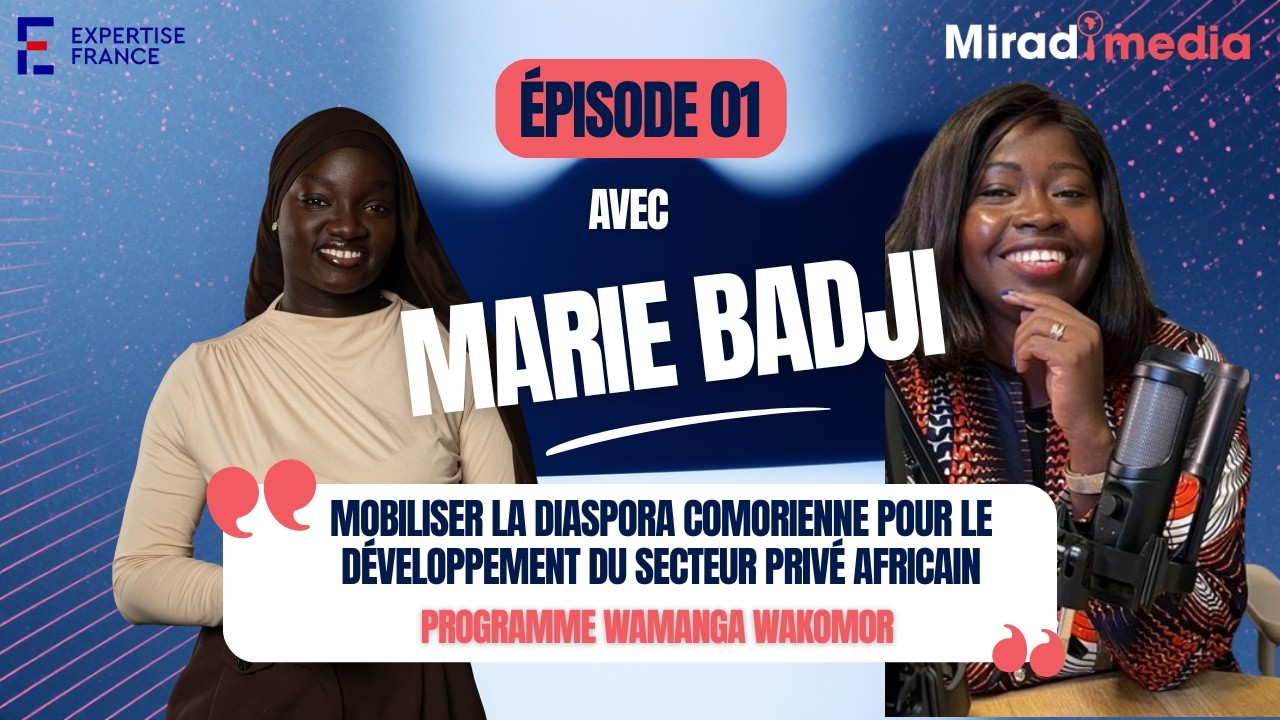
In this episode of Miradi Media, we welcome Marie Badji, Project Manager at Expertise France based in Moroni, to discuss the Wamanga Wa Komor program, an initiative aimed at mobilizing the Comorian diaspora as a driver of economic development.
In response to a model historically centered on family remittances, the program offers a structured approach to channel investments toward productive, sustainable projects with strong local impact.
Listen to the full episode on your favorite platform:
Subscribe to Miradi Media to discover more impactful initiatives.
Visit our platform to learn more about private sector support in Africa:
https://miradi.media/fr
#MiradiMedia #Diaspora #Comoros #Entrepreneurship #EconomicDevelopment #Investment #Africa #Impact #Innovation #Podcast #WamangaWaKomor #Africa
Welcome to Miradi Podcast, the voice of African private sector stakeholders, a Miradi Media production. Each episode gives the floor to the project manager and the program coordinator to analyze strategies, explore contexts, impacts, concrete achievements, and challenges across the continent.
Listen and learn via Miradi Podcast to better understand, make better decisions and take better action.
Dear listeners, thank you for joining us today for this podcast exploring private sector support programs in Africa. Today, we'll be visiting the Comoros archipelago and learning about a program called Wamanga Wakomor.
And we are fortunate to have the pilot here with us, Marie Badji. Hello Marie, thank you for joining us.
Hello Fary GUEYE, delighted to participate in this podcast episode and thank you for the invitation to highlight this Wamanga Wakomor project, but also the Comoros archipelago, this beautiful island located in the Indian Ocean.
Thank you Fary.
With pleasure. So perhaps before we begin, I'll let you introduce yourself, tell us about your role in Wamanga Wakomor and also perhaps tell us what Wamanga Wakomor means in concrete terms.
So, I'm Marie Badji, project manager for entrepreneurship and investment support for the Comorian diaspora. The project's shorter name is Wamanga Wakomor, which means Comorians in the diaspora. It's a wonderful project that I'm fortunate enough to lead, funded by the European Union and implemented by Expertise France, part of the AFD Group.
Ah, that's really interesting. I'm already eager to see how it turns out because you mentioned the diaspora being involved as well. So, if I'm not mistaken, this is your first program in the Comoros. How's it going? How was the reception? Apparently, the Comorian welcome is quite special, quite good. So, how were your first few weeks in the Comoros?
So, it was a warm welcome, really very dynamic. You should know that I also come from the Senegalese diaspora. So I'm Franco-Senegalese, and really, between Senegal and the Comoros, there are two peoples who are culturally similar, and I was very well received.
So as soon as I state my Senegalese identity, Comorians immediately find themselves in this Senegalese culture as well, and that is also the advantage of being from a diaspora and leading projects in multicultural countries.
So I was very well received by the Comorians and it's a country with many similarities to Senegal. So culturally, I didn't feel out of place at all.
Okay, that's great. Because I'd also heard that the Comoros and Senegal have a lot in common. So that's really good. So I think that helped you with the implementation.
So today in the Comoros, what could have generated this project? What observation led to the creation of Wamanga Wakomor?
So, the Wamanga Wakomor project is a European Union initiative. We started with a very simple observation: the need to structure the entrepreneurial ecosystem. Therefore, the European Union wanted to further strengthen support structures for entrepreneurs and the private sector in the Comoros.
So through this Wamanga Wakomor project, the idea is really to transform the energy of the Comorian diaspora into an engine of local economic development.
And it's very simple, it's really about supporting entrepreneurs, strengthening support structures, and above all, creating a climate of trust. It's a word that keeps coming up and that I've noticed since my arrival in the Comoros: the word trust.
And the idea, by creating a climate of trust, is so that investors and investments, particularly from the diaspora, are no longer just
…only family farms, but more productive. So this is really the observation on which the European Union, but also Expertise France and the AFD group, started to implement this project.
Today, you're talking about redirecting this family investment towards a more productive one. But in concrete terms, how do you convince a member of the diaspora to invest this money in a program? Because these are sums they put towards family life, towards everyday needs. What specific argument do you give them?
So, the idea is not to replace family transfers. What we are offering is a complementary service, therefore a secure, transparent and supported framework for those who want to go beyond family support.
Moreover, the Comorian National Agency for Investment Promotion (ANPI) has begun doing excellent work in the Comoros in this regard. And the Wamanga Wakomor project aims to continue its support to convince members of the diaspora.
And perhaps that's what's missing. Earlier, I was also talking about trust. Perhaps they also need this secure framework to be able to invest in value-added projects, in job-creating projects that will also help build their confidence.
And with a trusted third party like the Wamanga Wakomor project, they will feel much more secure because the projects will be supported. There will also be post-funding support.
And we ourselves, within the framework of the project, will also put in place innovative financial tools to test these project leaders and see their reliability in being able to set up or even manage productive projects.
OK. So, in that sense, you're talking about financial instruments that you're putting in place to build their trust, but what exactly are these instruments? How does it work in practice?
So, specifically, on the Wamanga Wakomor project, we plan to implement tools such as pre-donations, refundable advances, or even tiered advances, therefore via turnover.
In practical terms, if we select a project leader who is involved in, for example, poultry farming, who has a farm, we can tell them: the first step, we will pay you this amount. Then, if you manage to make progress in the construction or implementation, we will pay another amount.
So it could be tiers, quite simply, or the person could make repayments, so zero-interest loans, and then also combine with bank loans.
Because we approached banks in the Comoros and they are very favorable for this type of support, so that we can then open bank loans to these project promoters.
Indeed, while we might say that trust is already established, you also mentioned investing in green or blue projects. This is also Wamanga Wakomor's focus, and these are projects that require significantly more time to become profitable.
Now, how do you get these investors to accept this timeframe so that they can still invest their money?
Yes. So, first of all, to return to the choice of the green and blue economy, these are the most strategic sectors for the future of the Comoros.
In concrete terms, we are really on an island surrounded by the sea, with a lot of diversity in terms of ecology and environment, and these are among the key sectors, particularly of the Emerging Comoros plan.
So, to answer your question, to reduce risks and convince investors, we favor simple models adapted to local realities.
So, regarding the choice of projects, these are projects that still have a certain level of
These are mature companies that have proven their model and are simply looking to scale and achieve a certain level of growth. Therefore, these are well-chosen projects that will also receive excellent support.
So there are already other programs that are doing fantastic work. I'm thinking of the European Union's APiE project, but also the AFD Diaspora project.
And so these projects have already supported project leaders who have a certain level of maturity and this allows the Wamanga project to build on existing structures in order to convince investors to invest in projects in the blue and green sectors.
So indeed, as you were saying, these are promising sectors, especially considering the Comorian context. So it's an archipelago.
But so, once the trust factor is established, I wonder how you also choose who in the diaspora can invest, can participate in this program.
So I understand that there's a profiling study phase in this program, which is highly anticipated. Could you briefly explain how this profiling study will be conducted and what parameters you'll consider to determine who can participate in this program?
Yes, indeed, that's a bit of a challenge with this project, because we're really dealing with several different profiles.
We work with entrepreneurs from the diaspora who are based in the Comoros. We also work with local entrepreneurs, but at the same time we work with investors from the diaspora. We will also leverage the high level of expertise within the Comorian diaspora.
So here we see that we really have several profiles to mobilize to participate in the economic development of the Comoros archipelago.
And so on this project, as you said earlier Fary, on the profiling study, that's what will allow us… I don't really like the word profiling, but there you go, I can't find another word to replace it yet.
It's about going to find the Comorians where they are.
And through this study that we are going to conduct for the Indian Ocean, but also East Africa, in France as well and also West and Central Africa, really where the Comorian diaspora has settled, it is to seek out profiles.
I was talking earlier about entrepreneur profiles, especially with the window where we will present our ideation window to encourage young entrepreneurs from the diaspora, but also entrepreneurs who are in the Comoros, to propose concrete solutions in the blue and green sectors.
This study will also allow us to seek out investor profiles from the diaspora to convince them to come, with the ANPI, the National Agency for the Promotion of Comorian Investments.
And the third profile, as I also mentioned, is the high expertise of the Comorian diaspora, which this study will allow us to identify.
In concrete terms, we will offer these profiles the opportunity to support the private sector, but also institutional actors such as the Diaspora Commission, the ANPI I mentioned earlier, the Union of Chambers of Commerce (UCCIA), the Franco-Comorian Economic Chamber, and even the Comorian International Cooperation Agency.
So the idea is really to go and find these Comorians, to be able to convince them, to create this link of trust so that they can invest, whether it be in human capital, but also in impact investments, but also social investments.
So the Comorian people, as I often say, are a people who love their country and they are a people who always return home. And that is truly wonderful.
The Comorian always returns home. He always wants to invest back home, whether it's investments
community investments, family investments, but it always comes back, and that's what's so great about it.
And perhaps they just need that bond of trust. And it's not just the Comorian diaspora. As I said earlier, I myself come from the diaspora, I've been able to invest, I've been able to start businesses, so I know what it's about.
And so we'll be able to speak the same language to try and contribute to economic development through this Wamanga Wakomor project. Frankly, it's very beautiful to see, very inspiring too.
And as I was also saying, it's true that the Comorian diaspora is known to have a very strong link with the people of the country.
But also, what I wonder is: even if, as you say, many different profiles are identified, how do you ensure that it is not only focused on a small group?
Because often, in every context, there's always one group that captures information and gets the opportunities first. So how do you ensure that this isn't the case with this program?
And really, the idea is sometimes complicated because when we say "the diaspora", it's everywhere. Especially the Comorian diaspora: it's in France, it's in Senegal, it's in Reunion Island, it's in Madagascar, and even now in Canada.
So we will use different channels, whether on social networks, in particular by relying on certain highly followed personalities, but also in universities.
We will be conducting awareness campaigns in Comorian universities. And I myself will be travelling to these countries with the project team and all the institutional stakeholders.
We will soon be in Dakar with the Diaspora Commission to meet with the Comorian community living there. This will be an opportunity to exchange ideas with them and present the project.
It's true that there will always be blind spots, as I said, but we're going to try to reach everyone and talk about it everywhere.
Ah, that's great. I think that involving everyone, democratizing this participation, is what we need for this type of program, and especially for the objective you want to achieve.
And today, in terms of beneficiaries, what is the typical profile? How do you plan to choose them?
So, there are several profiles. I mentioned it earlier, but the first beneficiary is the entrepreneur, who is really the main target of this project.
Whether it is an entrepreneur from the Comorian diaspora, a local entrepreneur, or even someone who wants to move towards an ecological transition of their business.
And I would say, it's the entrepreneur who wants to create jobs, but also the young entrepreneur in the making.
So through our ideation desk, which I mentioned earlier, we will support concrete solutions to facilitate the creation of new ideas and new projects.
And today, how is the program actually being implemented? Do you pair investors from the diaspora with those who are present locally?
So, very quickly, we also talk about the structuring of the entrepreneurial ecosystem with the SAEs.
And what we did during this project launch phase was co-construction. As I often say, it's a project that we will build with all the stakeholders in the ecosystem.
And that's what's great, because we held bilateral workshops with all the support structures that responded to a call for expressions of interest launched by Expertise France.
So we had about nine, which was fantastic. We had nine at the Comoros level, so structures supporting local entrepreneurship, and we had four at the international level, so structures from other countries.
And the idea is to create a common foundation with these structures. That is to say, structures that have a certain level of maturity, that are abroad, in France, etc., can support local structures, and transfer skills in both directions.
And that's what will also allow the ecosystem to grow.
So we didn't want to create pairs that would respond to calls for projects where sometimes the lead partner is much more advanced than the other. The idea is really to work on skills transfer so that, when calls for projects are launched, it's Comorian organizations that can respond.
And that's very good. And it allows me to return to what I was saying, particularly regarding the common foundation we want to establish on this Wamanga Wakomor project.
We spoke with all the stakeholders, whether financial operators, entrepreneurship support structures, or institutional players, and the missing word was really the circulation of trust.
That's what was missing.
Simply because the banks told us: if we invest, if we support project leaders, they are not followed up. So there is an obstacle in the post-financing phase.
If we finance entrepreneurs, they are not always very sound, because sometimes the applications are poorly prepared. But the business support organizations tell us: we are unable to properly support project leaders.
So we took all of these needs and said to ourselves: we will create a common dialogue with the Wamanga Wakomor project, which will position itself as a trusted third party.
So what does that mean in concrete terms?
This means that the project will support business support organizations (BPOs), which are structures that support entrepreneurship. The project will also support banks.
Within banks, sometimes loan officers struggle to respond effectively to project promoters and to properly prepare loan applications.
So we will train the support structures, we will train the financial operators and then we will jointly identify the project promoters.
So there is this framework where it will not just be the project that identifies the project leaders. It will be a committee composed of support structures, financial operators, and the Comorian guarantee company.
And we will select these project leaders and then support them.
Once the support is completed, the project will provide funding, but this will be backed by co-financing.
So that means that these projects, particularly for the ecological transition window but also the diaspora window installed in the Comoros, will have to provide co-financing.
For the ideation grant, it's more complicated. We're not going to ask young project leaders to put up funds.
But for companies that have reached a certain level of maturity, we will seek co-financing. And together, we will approach banks and investors to request additional funding.
So this is really the framework for dialogue that we wish to put in place on this Wamanga Wakomor project.
So that means that the key word of this program is collaboration, bringing together different actors, different profiles.
And so I imagine that, like any multi-stakeholder program, it requires a lot of coordination, because there are different ways of working.
How does it work? I imagine there are occasional frictions, because they are different people. How do you, as a project manager, resolve this issue?
But it's about everyday diplomacy, and dialogue and listening too. So it's not easy to manage a project that is cross-cutting, that speaks to the diaspora and that has a dedicated actor, namely the Diaspora Commission.
This is also a project that affects the economy and investment with the ANPI, the National Agency for the Promotion of Investments, but also the Ministry of Economy.
This is also a project with financial operators, therefore with the Ministry of Finance and the Directorate of Banking Reforms as well.
So sometimes there may be some misunderstandings, but with daily diplomacy, we still manage to listen to everyone, and that's what's great.
Expertise France is an organization that serves its partners. And that is very important.
We start by listening, we take into account the needs and together we find solutions that are put in place to meet those expectations.
So, since the beginning of the project, since you arrived in the Comoros, have you had to readjust certain parts of the program because you received comments or criticisms, or because you realized that what you had planned no longer corresponds to the demand?
Yes, indeed. You know Fary, when we write a project, we can co-create it with all the stakeholders, but sometimes, with the landlord's expectations, we realize that in the end, the reality on the ground prevails.
We had to readjust our approach.
I was talking earlier about co-construction. Even though the project was written with all the stakeholders, sometimes more institutional and less technical stakeholders on the ground, talking with everyone, exchanging ideas with everyone, led us to readjust.
For example, the fact of now entrusting the selection to the support structures that will manage it, even if there will be a committee with the project team and other actors, as I said earlier.
Being able to trust the support structures and to increase their capacity was a major readjustment of this project.
Because the idea is really to grow the entrepreneurial ecosystem, so that investors have confidence, so that support structures are positioned as business providers to banks.
Because that's what's important. When we talk about entrepreneurship, we're constantly told that access to financing is the major issue.
But what do we actually do?
The banks tell us: we have excess liquidity. OK, you have excess liquidity, but what's stopping you from financing entrepreneurs?
So, here we've touched on this issue of trust and trusted third parties.
And that's why we want to empower everyone, but at the same time build and readjust the project with all the stakeholders.
Yes, that's essential.
But earlier you also spoke about this capital of trust, but also about a financial arrangement that allows different actors to be involved, particularly for projects in the ideation phase or even more advanced projects.
But how do you avoid addiction?
Because often, if you start with a good guarantee of funds, you can tell yourself: it's not a big deal, my project will evolve, but there will always be Expertise France to help me, they are not going to let my project fail.
So how do you prevent this dependency?
And that's really co-financing.
We're going to seek co-financing to increase our accountability. Because if I approach organizations or funders who only give me a direct grant, I'll put in less effort. But I know they'll ask for co-financing, and even if it's from friends and family, I'll find a way to secure it.
And so, that alone is the first step that entrepreneurs are taught: to seek funding. And that, in fact, is the life of an entrepreneur.
Beyond marketing, it's really about access to financing. That's the crux of the matter; it's ultimately about money.
Yes. And so, by requesting co-financing so that entrepreneurs seek funding elsewhere, I think it's a good start to empowering entrepreneurs.
Yes, I think so too. In any case, once we invest our money, we really follow the project.
So today, in terms of impact, what are the invisible or more subtle impacts you expect from this program? Are there things that don't necessarily appear, or that the figures won't show you, but that will allow you to see that things are really moving in the Comorian ecosystem?
Yes, indeed Fary, there are impacts that cannot be quantified, what we call invisible impacts.
And today, with this project, it will be about the circulation of trust. That is to say, that the diaspora can have confidence in the institutions, that entrepreneurs have confidence in the institutions, in the support structures, and that the banks also have confidence.
So it's really about this circulation of trust.
In terms of measurability, it's difficult to measure, but it will be observable if we manage to implement this. And that's truly the invisible impact expected in this project.
I imagine so, because trust is very important. But do you think that this trust can also be a hindrance?
If it's not established, it could impact the program. Do you have any alternatives to work around this problem?
No, I want to tell you that we're not giving ourselves a choice. It's this or nothing.
Yes, you're right. We're going to establish it. And we've already started; that's what we're doing now.
So the idea here is really to create this bond of trust, and that's very important.
Don't give yourself a choice: whether it's plan A, B, or C, that's it. Because even if it's not quantifiable, that's what the project will leave behind: this flow of trust between all the stakeholders, and showing that it's possible.
So we leave ourselves no choice.
Ah, you're right, it's this or nothing. In any case, we all want to see this program materialize, achieve its objectives, because the entire Comorian ecosystem will benefit from it, and even other programs in other countries.
So I hope that in a year or two, I will have news from Wamanga Wakomor that will give me even more hope about how the diaspora can get involved in its country.
We will get the results, that's for sure.
It also allows me to launch an appeal to the Comorian diaspora so that they can listen to this podcast, see what the project aims to do.
And I often say that we're in this together. And when I say "we're in this together," I really mean we're in this project together.
So, during the study that we are going to launch, we invite you to respond to the call for projects for project leaders, with the three funding windows as well.
So, we invite you to take an interest in the Wamanga Wakomor project.
Yes. And how can they do that? Are there mechanisms in place to allow them to follow and participate in this program?
So to participate in this project as an investor, you can get in touch with the project team, myself and my colleagues, the ANPI as well, or support structures for entrepreneurs, such as the SAEs which are in the Comoros.
Information sessions will also be held when the time comes.
So, we're at the beginning of the project, and it's important to mention that because sometimes the waiting time is very long. So there's a lot of impatience. There's no one more impatient than an entrepreneur, and you're right about that.
And what we want to do here is first and foremost to support the support structures and financial operators. Then, we will open the various service points I mentioned earlier.
So there will be this waiting period, and we will also communicate regularly. We will set up newsletters, even if there are no calls for projects yet, to keep you informed of our progress.
That is to say: at this stage, we are training the support structures, the banks, on this or that aspect.
We will also launch calls for applications so that the diaspora can respond, whether in the green and blue sectors, but also in the banking sectors, especially everything related to financial analysis, in order to come and support us in this project.
So.
Very interesting. They certainly have enough material to follow the progress of this program.
Yes. And will there also be discussions with the diaspora, even for those who are not part of the program? Because it is a subject that requires a lot of exchange and is the subject of much debate.
Do you also plan to include that in the program?
So, we will organize opportunities for dialogue with the diaspora. We will take advantage of the study's tour to connect with civil society and the diaspora.
Moreover, I didn't mention it: this project has two components. The entrepreneurship and investment component is implemented by Expertise France, and the civil society component is implemented by Initiative Développement.
And so we are really going to pool our strengths to go and exchange with the diaspora.
ID has already begun to do a tremendous job by reaching out to civil society associations in the Comorian diaspora, and we will also identify the high expertise of the Comorian diaspora.
OK, great, very interesting.
Now, I'd like us to delve a little deeper into your role as project manager.
First, a very basic question: would you prefer a workshop with, say, 50 participants, or working on a very strategic report?
So, it's difficult to answer. Perhaps if I had no other choice, I would say lead a workshop.
I love exchanging ideas, I love dialogue. And with these workshops, we always come away with a lot of knowledge.
In fact, I was just talking about the bilateral workshops we held with the support structures, who thanked us, saying that thanks to these workshops, they were able to identify their needs and positioning.
Because sometimes, certain structures positioned themselves as accelerators, and with this exercise, they realized that they were more like incubators.
So these workshops helped them to identify their needs but also their positioning.
So I would choose a workshop.
OK, I think it's very important to know that.
And today, does the fact that you are not Comorian — as you said earlier, that there are similarities between Senegal and the Comoros — does this difference in nationality give you more freedom, or on the contrary, a certain responsibility in the way you manage this program?
I would say both. In the sense that it's an outside perspective that I can bring. It's expertise that I've acquired in other regions and that I can draw upon, but also a great responsibility, particularly a responsibility to listen and engage in dialogue.
So it is really complementary between the freedom to come from the outside and the responsibility to listen, to dialogue and to co-construct with all the actors.
And today, what major lesson have you learned from your field immersion?
So the main lesson, since I settled in the Comoros, is really the strength of community and family networks that support projects.
We're talking about 300 million per year, which is 20% of GDP, and that shows the solidarity of the Comorians. And that really struck me.
We see road construction carried out by community networks, mosques, schools, etc.
And that is truly a great lesson for me, which I look at with great admiration.
Very beautiful to see.
And what advice would you give to a diaspora entrepreneur who wants to invest remotely in the economic development of their country?
I want to tell them: don't do anything alone.
An entrepreneur who wants to succeed, especially if they are in the diaspora, needs to find a reliable structure to support them and move forward step by step.
Don't be in a hurry.
Sometimes it is difficult to invest or start a business remotely, because at the beginning you need a salary, unless you already have the necessary funds.
But generally, an entrepreneur will keep their job and start a business on the side.
So it’s really important not to go alone, to be accompanied by local structures, who know the context and can help to invest effectively.
Indeed. And this advice could also apply to other countries wishing to mobilize their diaspora?
Yes, of course. This is not specific to the Comorian diaspora; it applies to all diasporas.
And if I have one piece of advice to give to a country, it is to start with trust, to make its diaspora feel comfortable, to use its human capital and expertise.
This is what then allows for the creation of a flow of trust, transparency and clarity in roles.
And then we can talk about investment.
We have seen it in other contexts: it is the commitment of the State that makes the diaspora feel more confident.
Once the state is transparent in its roles and relationships with institutions, everything works better, and the diaspora responds positively.
Perfect. Thank you very much, Marie.
We have reached the end of this program. Thank you for taking the time to participate.
I personally learned a lot, and I hope that's also the case for our listeners. I learned a lot about the Comorian diaspora, about how to engage them in a program like Wamanga Wakomor.
How to use the 20% they invest each year in their country for more productive investments, particularly in green and blue economies, which are adapted to the island context of the Comoros.
It was really very exciting and I can't wait to see what happens next in this program.
Looking forward to seeing how entrepreneurs will take advantage of this.
Let's meet again in a few months, a few years to see the results.
See you in a year to introduce you to the project leaders, and in the meantime, see you in a few months to introduce you to the support structures and financial operators who have also been supported.
Thank you to those of you listening. Thank you also for this invitation which has allowed us to present this Wamanga Wakomor project, which is funded by the European Union and which I have the privilege of leading.
And with pleasure, if you would like more information on this project, I remain available along with all my colleagues.
You've heard it, so stay tuned.
Thank you very much Marie, and we'll see you very soon on another episode.
See you soon.