


Ep. 2
48:34 min
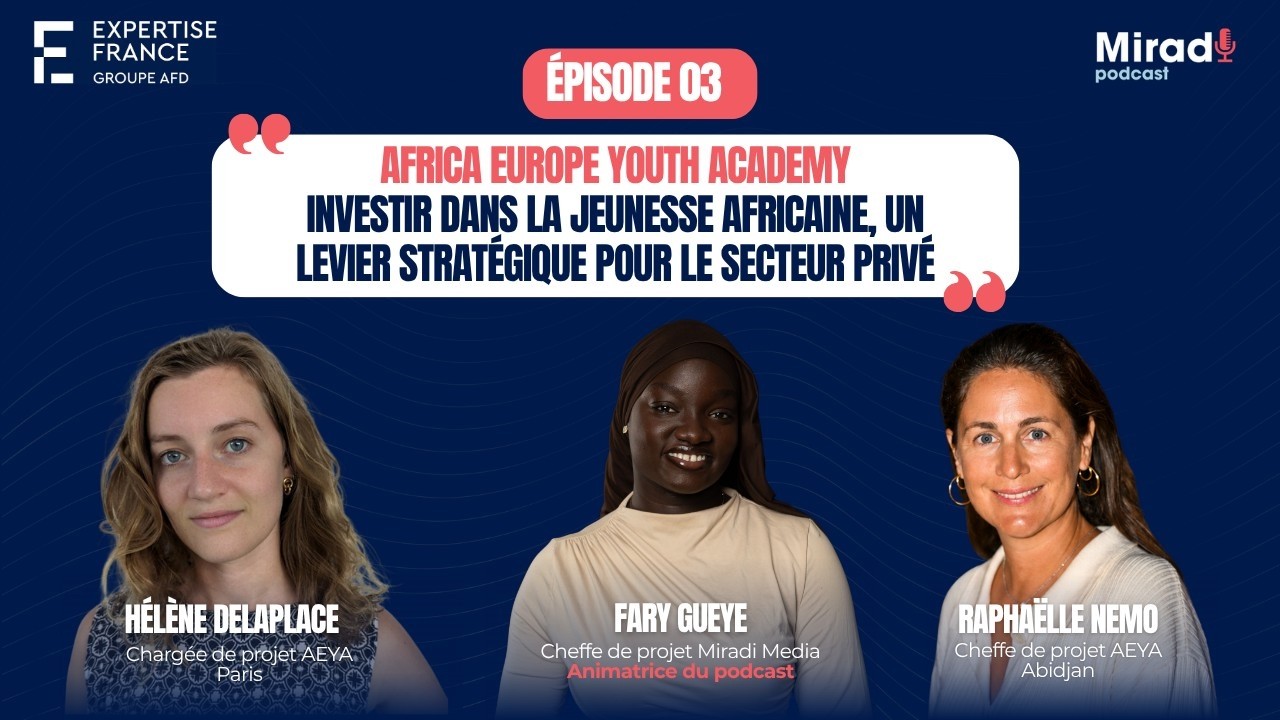
Dans cet épisode de Miradi Media, nous recevons Raphaëlle Némo, cheffe de projet terrain à Abidjan, et Hélène Delaplace, chargée de projet au siège d’Expertise France, pour échanger autour de l’Africa Europe Youth Academy (AEYA). Financé par l’Union européenne, ce programme soutient les jeunes leaders dans 20 pays d’Afrique subsaharienne.
Face aux défis d'insertion et d'accès aux opportunités, le programme propose une approche ambitieuse : renforcement des capacités, accompagnement des jeunes leaders, soutien aux espaces de jeunesse et mise en réseau. Au-delà du simple développement de compétences, AEYA agit comme un moteur pour structurer l’écosystème entrepreneurial et renforcer le secteur privé local. Nos invitées explorent les enjeux de la mise en œuvre multipays, l’inclusion des profils vulnérables et les mécanismes concrets pour transformer le potentiel de la jeunesse en un levier durable de croissance économique.
Pour en savoir plus, accéder aux appels à candidatures et suivre les actualités du programme (AEYA Insight), consultez la page officielle sur Capacity4dev : https://capacity4dev.europa.eu/groups/africa-europe-youth-academy-aeya_en.
Fary GUEYE : Bonjour à tous. Merci de nous rejoindre pour cet épisode de Miradi Podcast. Aujourd'hui, nous allons parler d'un programme qui va vous faire découvrir pas un pays, pas deux, mais plusieurs pays à l'échelle du continent, et qui est une initiative très importante qui vise la jeunesse. Pour en parler, nous avons les deux chefs de projet : Raphaëlle Némont, qui est chef de projet terrain au niveau du bureau d'Abidjan, et Hélène de Laplace, qui est aussi chargée de projet de ce programme-là au niveau du siège d'Expertise France à Paris. Bonjour Raphaëlle, bonjour Hélène. Je vous laisse vous présenter et nous parler du programme un peu plus.
Raphaëlle : Je commence ? Droit d'aînesse ? D'accord. Moi, je m'appelle Raphaëlle, je suis chef de projet chez Expertise France et plus précisément responsable du projet Africa Europe Youth Academy qu'on appelle AEYA, son petit diminutif. Je suis basée au bureau d'Expertise France d'Abidjan avec le reste de l'équipe. On est 6 en tout sur ce projet à être sur le terrain, et on a l'appui d'Hélène qui est à Paris.
Hélène : Et du coup, moi c'est Hélène Delaplace, donc je suis chargée de projet au siège au sein d'Expertise France et en charge notamment de ce projet AEYA.
Fary GUEYE : Super, merci beaucoup pour cette présentation. J'ai hâte d'avoir cette discussion avec vous, sachant que vous avez, j'imagine, deux perspectives différentes parce que vous avez l'approche terrain et l'autre au siège. Pour commencer, peut-être que vous allez nous reparler de ce programme, donc l'AEYA. Vous allez nous donner plus de détails sur en quoi ça consiste, qui sont les bénéficiaires et où est-ce que vous en êtes aujourd'hui.
Hélène : Alors l'AEYA, c'est un projet financé par l'Union européenne, qui est ce qu'on appelle un projet multi-pays, qui couvre 20 pays d'Afrique subsaharienne. Le budget total, c'est 15 millions d'euros, et ça va durer quatre ans en tout. L'objectif, c'est de renforcer les capacités en leadership des jeunes en Afrique à travers ces 20 pays. Donc, dans notre définition des jeunes, c'est la tranche d'âge 18-30 ans. On déploie ce projet Expertise France en partenariat avec l'AICS, qui est l'Agence de Coopération italienne. C'est l'équivalent d'Expertise France côté Italie. Donc on est dans un consortium ensemble et on s'est réparti, en fait, les volets d'activité et/ou les pays. On va pouvoir vous en dire plus tout à l'heure. On n'a pas encore démarré à proprement parler nos activités. On va vous en parler, vous dire un peu tout ce qu'on a prévu. L'année dernière, en fait, on a eu une année de ce qu'on appelle une phase de lancement, où en fait on a préparé les activités et on a essayé de cibler au mieux pour que les activités prévues répondent au mieux aux besoins de notre cible. Est-ce qu'Hélène, tu veux présenter les volets d'activité peut-être ? Et donc on a été lancés le 1er février 2025, c'est ça ? Donc ça fait... Non, 2025. Ça fait un an en gros qu'on s'est lancés.
Fary GUEYE : Merci.
Hélène : Il y a trois volets d'activité. La première composante porte sur le soutien aux espaces de jeunesse. L'idée est de distribuer des subventions, notamment à des espaces qui seraient créés par les jeunes et aussi pour les jeunes sur le continent, avec un volet également de renforcement de capacités et de formation. La deuxième composante s'adresse plutôt aux jeunes en tant que personnes, aux jeunes leaders, porteurs de projets. Quand on dit jeunes leaders, on entend à la fois un jeune à l'échelle de sa communauté qui peut résoudre des problèmes, mais aussi un jeune entrepreneur ou alors un jeune acteur civique, mais attention, pas partisan. Et donc la deuxième composante vise à les former et également à renforcer les capacités des incubateurs ou des centres de formation dans les pays d'activité. Et la troisième composante, elle, est plus transversale et elle est gérée par l'agence italienne. Elle comporte un volet formation en ligne qui sera donc accessible aux jeunes africains mais également à travers le monde, et un volet mentorat en ligne dans lequel on veut également inviter des jeunes européens, et notamment des alumni de programmes de l'Union européenne, ainsi qu'un volet final d'événements locaux pour les aider à se connecter entre eux.
Fary GUEYE : Ok, d'accord. Merci beaucoup pour cette présentation. Vous avez pris un an pour faire la phase de conception, de préparation ou de lancement. Donc aujourd'hui, comment est-ce que vous abordez ce passage à l'action pour les prochains mois ? Autant sur le terrain qu'au niveau des certifications.
Raphaëlle : Je dirais qu'on l'aborde de façon sereine et confiante. En tout cas, je dirais confiante, parce qu'on a quand même la force de notre équipe. Et oui, parce qu'il y a eu un gros travail dans la phase de conception. D'ailleurs, moi, je n'étais pas habituée à des phases de lancement aussi longues. Et au début, quand Expertise France m'a recrutée, ils m'ont dit qu'il y avait huit mois de phase d'inception, ça me paraissait une éternité. Je me suis dit : "On va perdre du temps, il faut qu'on commence plus vite." En fait, non, c'était plus que nécessaire. D'ailleurs, on a mis un peu plus que huit mois dans les faits parce que voilà, c'est super important de bien penser le projet. Ça nous a permis notamment de faire le tour de la plupart des pays, de faire des séances de consultation avec les jeunes, de mieux comprendre les écosystèmes. Et puis après, puisqu'il s'agit d'argent public, il y a aussi tout un volet juridique qui est quand même assez important et assez lourd avec des procédures et des étapes par lesquelles on ne peut pas ne pas passer, donc il fallait aussi prendre le temps, voilà, de faire les appels d'offres, les appels à projets, etc., pour commencer à choisir nos partenaires, et puis même rien que de recruter, en fait, recruter notre équipe projet. Donc je vous disais tout à l'heure, on est six à temps plein sur le projet de la partie EF, plus l'appui d'Hélène. Et on a aussi des points focaux dans les pays. Donc on a aussi 10 points focaux dans les 10 pays d'intervention où Expertise France va gérer plusieurs volets d'activité. Donc il fallait également faire ce processus d'identification et de sélection de ces experts terrain.
Fary GUEYE : Donc ce ne sont pas nécessairement des experts d'Expertise France, pour les points focaux, ce sont aussi des structures locales ?
Raphaëlle : Exactement, en fait ce sont des consultants, donc ils ne sont pas à temps plein sur AEYA. En fait, on fait appel à eux en fonction des besoins et de l'évolution du projet. Donc par exemple, dans la phase de lancement, ils nous ont appuyés pour faire des études de l'écosystème, des mappings d'acteurs, etc. Mais là, après, voilà, leur rôle va évoluer en fonction des besoins. Ils sont un peu nos yeux et nos oreilles dans les pays d'intervention pour voir comment se passent les activités, pour aller parler aux bénéficiaires, pour aller débloquer des choses si besoin avec les partenaires, etc. Mais du coup, pour revenir à la question initiale, moi en tout cas, je me sens... on n'est pas à l'abri d'un imprévu, bien sûr, mais je me sens plutôt sereine et confiante dans ce travail qu'on a fait et dans ce qu'on prévoit de faire pour avoir un impact auprès des jeunes.
Fary GUEYE : C'est très rassurant, j'ai hâte de voir les premières étapes de ce programme-là. Donc pour vous Hélène, coordonner ce programme-là qui compte plusieurs pays depuis votre bureau de Paris, j'imagine que c'est un défi logistique et humain assez considérable. Comment est-ce que vous vous y prenez aujourd'hui pour ne pas perdre cette réalité du terrain ?
Hélène : Oui, je pense que d'abord la première chose, c'est d'avoir créé un lien fort avec Raphaëlle et avec l'équipe aussi sur le terrain. Aussi, même en termes de... Il faut s'imaginer que le projet, avant d'être lancé (donc ça fait déjà un an), mais en fait il existait déjà un an avant dans notre tête au siège, puisque nous on s'est lancés dans une grande phase de ce qu'on appelle le développement du projet. Donc là j'étais en lead, en fait j'étais toute seule avec mes équipes transverses et évidemment... le département, voilà, on imagine un projet de A à Z avec l'Union européenne, avec les partenaires du consortium, donc en l'occurrence l'AICS. Donc là, c'est vraiment le siège qui gère ça. Ensuite, on recrute une équipe sur le terrain et là, on essaie d'avoir une bonne relation qui assure du coup une complémentarité entre le siège et le terrain. Et l'enjeu aussi, c'est vraiment la décentralisation, parce que chez Expertise France, la majorité des staffs sont vraiment sur place. Donc ça fait partie de notre ADN aussi de décentraliser. Et puis l'essentiel, c'est de s'appuyer toujours sur des acteurs en local. Moi, je ne vais rien décider toute seule depuis le siège, évidemment. Et donc la méthode, si je devais en avoir une, ce serait vraiment de travailler main dans la main avec les équipes terrain et avec les partenaires locaux.
Fary GUEYE : Oui, donc ça veut dire beaucoup de coordination entre différents acteurs. J'imagine que ça ne doit pas être aussi facile que ça, surtout que c'est dans plusieurs pays.
Hélène : C'est vrai que nous, on est à la fois RH, on commence à développer des compétences de juriste, même de management, on est vraiment multitâches, ça c'est sûr.
Fary GUEYE : Mais donc c'est de là d'où l'importance aussi d'avoir fait cette phase de conception, de lancement qui a duré quand même longtemps pour pouvoir mieux vous familiariser avec vos équipes. Super intéressant, en fait, comme le disait Raphaëlle, c'est quelque chose qu'on ne voit pas souvent dans les programmes de développement. Parfois ça dure un peu moins de huit mois, mais c'est intéressant, surtout pour un projet de cette ampleur. Mais donc pour revenir, oui, allez-y, Hélène, peut-être ajouter quelque chose ?
Hélène : Non mais c'est aussi que souvent on pense qu'Expertise France va aller directement sur le terrain, distribuer 50 subventions ou former directement, mais ce n'est pas le cas. Nous, on a en effet des pools d'experts, mais on travaille surtout à travers des structures intermédiaires. Donc c'est aussi tout ce qu'on a fait dans cette année. C'était aussi contractualiser, comme le disait Raphaëlle, avec les structures intermédiaires qui sont des structures locales. Donc ça, ça prend énormément de temps.
Fary GUEYE : Totalement. Mais donc pour vous, Raphaëlle, au niveau du bureau d'Abidjan aujourd'hui, cette année-là où vous avez pu plus comprendre le contexte, l'écosystème et vos bénéficiaires, quels sont les besoins les plus notables au niveau de ces jeunes que vous remarquez ?
Raphaëlle : Merci, il y a beaucoup de besoins, donc je vais essayer de récapituler, ça ne sera pas forcément une liste exhaustive. Et puis, les jeunes qui nous écouteront pourront penser évidemment à d'autres choses. Mais je dirais qu'il y a un besoin de monter en compétences, donc des compétences hard, notamment tout ce qui est entrepreneurial, donc la gestion financière, la structuration juridique, etc., et aussi des compétences soft, donc avoir un esprit critique, savoir travailler en équipe, savoir communiquer pour avoir de l'impact, ces choses-là. Ça leur manque beaucoup, c'est souvent pas appris sur les bancs des universités. Donc notre programme, j'en parlerai tout à l'heure, de formation en leadership, va pas mal porter sur ces notions-là. Un autre besoin, ce serait l'accès à des réseaux. Plusieurs types de réseaux, mais je pense notamment à des réseaux d'investisseurs, des réseaux de mentors. C'est super important aussi d'avoir un peu... d'avoir des exemples en fait, d'avoir des rôles modèles, comme on dit, de pouvoir s'inspirer de parcours de réussite locale, pas que de Steve Jobs, mais d'avoir aussi des modèles de succès et aussi d'échecs dans son pays ou bien dans son secteur. Ça me semble important et ce n'est pas toujours le cas, malheureusement. Et puis, peut-être aussi un besoin d'apprendre à se familiariser et à naviguer dans les dispositifs publics, les dispositifs des bailleurs. C'est vrai que c'est quand même tout un autre monde. Même moi parfois ça m'effraie alors que je suis dedans, mais le jargon, les plateformes, tout ça c'est tellement loin des réalités d'un jeune africain lambda. Donc je dirais qu'il s'afallait récapituler les besoins les plus criants chez notre cible jeune, ce serait ça.
Fary GUEYE : Ok, totalement, je comprends. Et aujourd'hui, vous avez aussi plusieurs pays sur lesquels vous travaillez. Quelle est la logique qui est derrière ce choix géographique-là ?
Hélène : C'est la première question que j'ai posée en entretien d'embauche : pourquoi 20 pays en fait ? J'ai essayé de répondre du coup. Oui, non mais c'est la question qu'on s'est vraiment posée, ce n'était pas un choix qui s'est fait par hasard et c'est vraiment le challenge, comme le dit Raphaëlle, d'assurer une cohérence à travers tous les 20 pays et avec deux acteurs de consortium qui ne travaillent pas de la même manière.
Fary GUEYE : Ok, ouais... Oui...
Hélène : Nous, ce qu'on a voulu, c'était vraiment avoir une approche dans toutes les sous-régions d'Afrique subsaharienne. C'est une demande qui venait de l'Union européenne, qui a des délégations installées sur place. Ces délégations-là étaient aussi preneuses d'avoir ce projet AEYA qui se voit un peu partout. Ensuite, on s'est posé la question de où était le besoin. La réponse était que le besoin de soutenir le leadership des jeunes en Afrique, comme vous le savez, c'était vraiment dans tous les pays. Et donc on s'est dit : où est-ce qu'on peut aller sans qu'il y ait un coût d'entrée qui soit trop fort par rapport à ce qu'on peut apporter, et où on mettrait trop d'argent sur l'installation d'un nouveau bureau ? Et donc on s'est dit : allons dans les pays où EF a déjà des activités. On sait que l'AICS, l'agence italienne, s'est posé la même question et a décidé d'aller dans des pays où ils avaient déjà une activité pour pouvoir aussi capitaliser sur l'existant, puisque l'AEYA, c'est vraiment un projet qui s'insère en complémentarité totale avec plein d'autres programmes de formation en amont, en aval, on en parlera sûrement plus tard, mais quand on posera la question de la durabilité. Donc, voilà, c'est comme ça qu'on a choisi. Et puis, pour s'assurer quand même d'une certaine cohérence, on conçoit, en fait, des appels qui sont précis, mais aussi à la fois assez larges pour que les propositions qui nous soient faites par les acteurs locaux puissent s'adapter au contexte. Donc ça c'est la manière dont on a réussi à gérer la situation.
Fary GUEYE : Oui, puisque c'est un des points les plus importants que les gens se posent. Comment est-ce que vous faites pour harmoniser vos actions au niveau de tous ces pays-là ? Donc vous avez une répartition avec l'AICS et avec Expertise française pour les pays ? Oui.
Hélène : Et en fait, justement, c'est une bonne question de comment harmoniser à travers ces 20 pays, mais aussi comment justement pouvoir personnaliser l'approche, puisque ces 20 pays sont très différents. Donc le contexte d'être un jeune leader en Mauritanie aujourd'hui est tellement différent de l'être en RDC ou au Mozambique. Il faudrait... C'est un peu, voilà, c'est notre challenge clairement d'arriver à être équitables et à offrir un accompagnement
Fary GUEYE : Oui.
Hélène : pour tous, qui puisse aussi quelque part répondre à des besoins qui seront parfois un peu spécifiques. Je ne vous cache pas que ce n'est pas simple, parce qu'on n'a pas un budget extensible, on n'a pas un temps extensible, mais voilà, on va essayer de faire au mieux.
Fary GUEYE : Oui. Oui, non, totalement, je comprends. Et au niveau des bénéficiaires aussi, il y a un focus qui est fait sur la participation des femmes, donc à hauteur de 50 %. Donc, comment est-ce que vous faites pour garantir justement cette réelle participation des femmes dans des secteurs qui sont parfois un peu masculinisés ou très masculinisés ?
Hélène : Merci, c'est une vraie question. Alors non seulement on a cet objectif de minimum 50 % de jeunes femmes dans nos programmes, mais aussi de 25 % de jeunes qui viennent en fait de situations de vulnérabilité. Donc ce n'est pas un vœu pieux. Ce serait bien qu'on refasse ce podcast, disons dans trois ans, et qu'on voie ce qu'on a fait. En tout cas, vraiment, il y a une vraie volonté derrière. C'est au-delà d'un indicateur comme ça que l'Union européenne nous a mis dans le contrat. C'est clairement un incontournable. C'est une volonté qu'on a. C'est quelque chose dont on discute avec les partenaires. C'est même quelque chose qui fait partie... En ce moment, on a clôturé, en fait il y a quelques semaines, un appel d'offres pour les structures intermédiaires qui vont nous aider à délivrer notre programme de formation en leadership pour les jeunes dans chacun des 10 pays dont Expertise France s'occupe. Ça fait partie de ce qu'on va regarder justement, leur capacité à intégrer des jeunes filles, à intégrer des jeunes en situation de vulnérabilité, leur expérience à faire ça dans le pays en question par le passé, leurs recommandations aussi, puisque la notion de vulnérabilité, on parlait tout à l'heure de la différence des écosystèmes, etc., dans les 20 pays. On ne va pas forcément définir de la même façon la vulnérabilité des jeunes au Rwanda qu'en Guinée. Donc comment est-ce que ce partenaire local interprète et comprend cette notion-là et comment est-ce qu'il propose de l'intégrer ?
Fary GUEYE : Oui, du coup, une question aussi qui me venait à l'esprit quand vous parliez tout de suite, c'est comment est-ce que vous faites aussi pour que ces appels d'offres-là puissent arriver au niveau de vos bénéficiaires directement ? Parce que comme vous le dites, parfois, si ce sont des jeunes en situation de vulnérabilité, ils ne sont peut-être pas forcément connectés pour avoir accès directement à ces informations-là. Donc vous, au niveau de vos structures locales, ou bien même au niveau du bureau d'Expertise France, comment est-ce que vous vous y prenez ?
Raphaëlle : Oui, super question. Bon, déjà pour l'instant, juste pour bien remettre dans le contexte et dans le timing global du projet, on n'a pas encore lancé l'appel à candidatures pour les jeunes, bénéficiaires directs. Mais ça ne saurait tarder. Donc, par anticipation, je peux déjà un peu expliquer qu'en fait, on va évidemment... on a nos canaux de diffusion, donc je parle du LinkedIn d'Expertise France, du site internet, etc. On a aussi le site internet Capacity4dev de l'Union européenne sur lequel on fait toutes les actualités du projet AEYA. Tous les appels d'offres, les appels à candidatures sont dessus pour ceux qui ont déjà eu lieu, et seront dessus pour les autres. Et surtout après, on est en train de mettre en place un système de relais, un système de diffusion de nos offres en s'appuyant sur des relais dans les pays. Donc il y a nos points focaux dont on a parlé.
Fary GUEYE : Bon.
Raphaëlle : Il y a aussi nos jeunes qui font partie de notre Youth Advisory Board. On a un comité consultatif de jeunes qui sont aussi quelque part la voix d'AEYA dans les pays. On a toutes les structures qu'on a identifiées, qu'on a mappées dans la phase de lancement. On leur diffuse les opportunités et on leur demande de le faire aussi dans leur réseau. Donc pour l'instant, si je me base sur le nombre de candidatures qu'on a eues pour les appels à projets et les appels d'offres qui ont déjà été lancés, ça circule plutôt pas mal, l'information. Mais par contre, c'est vrai que ce sera un vrai challenge pour les bénéficiaires finaux et notamment ceux qui sont en situation de vulnérabilité, qui ont peut-être moins accès par la méthode traditionnelle d'information, les sites internet et tout ça, comment eux on va les cibler. Et encore une fois, on va vraiment s'appuyer sur l'expertise et l'expérience des structures locales qui, elles, sauront dire : "Nous on est basés, je ne sais pas, à Nouakchott, mais en fait on travaille avec telle ou telle ONG qui travaille avec les jeunes filles ou les jeunes handicapés ou les jeunes mères ou je ne sais pas, dans telle et telle localité, et qui seront en mesure de leur faire parvenir l'information, enfin l'opportunité."
Fary GUEYE : Oui, ok, ça c'est une approche assez décentralisée et je pense, j'espère en tout cas une fois que ça sera lancé, que vous aurez justement les résultats escomptés. Maintenant, on va entrer dans le vif du programme pour en savoir plus sur la mise en œuvre. Aujourd'hui, par rapport aux subventions que vous proposez, vous utilisez un mécanisme de subgrants. Donc ça, c'était décidé dès la phase de conception. Peut-être Hélène, si vous voulez justement nous parler de ce choix-là, de passer par des intermédiaires pour délivrer ces financements-là. Pourquoi d'abord ce choix et ensuite quels sont les critères justement d'attribution à ces opérateurs locaux ?
Hélène : Oui. Donc si on se focalise sur la distribution de subventions qui est une grosse partie de la composante 1, donc de soutien aux espaces de jeunesse, c'est vrai qu'EF n'a pas forcément vocation à être un opérateur en direct avec des structures. On préfère passer par des intermédiaires qui ont une meilleure connaissance du terrain et qui ont une capacité d'ancrage dans le territoire qui est bien plus forte. Et donc on a lancé un gros appel à projets pour identifier trois structures intermédiaires, donc une à peu près par sous-région. On a divisé les pays avec une cohérence plutôt linguistique. Et donc l'idée, c'est que ces structures-là, on aime passer par elles également parce qu'elles vont pas seulement distribuer les subventions mais aussi mettre en œuvre des activités auprès des jeunes. Donc ça va tout simplement de comment faire un reporting à comment... voilà, être un peu plus... développer son espace de jeunesse en lui-même. Et l'idée, c'est aussi que ces structures intermédiaires soient aussi, si possible, des structures gérées par les jeunes. Donc, chez AEYA, on essaye vraiment de s'impliquer... enfin voilà, de s'imposer à nous-mêmes ce qu'on prône en externe. Et donc, c'est vrai que même sur les structures intermédiaires, on est amené parfois même à faire du renforcement de capacités de ces structures-là ou au minimum de la formation, pour aussi leur permettre de se mettre à la page de toutes les exigences d'une agence publique. Donc on peut vraiment dire que AEYA, c'est par les jeunes pour les jeunes aussi à ce niveau-là. Et sur les critères de sélection, on a sélectionné des structures intermédiaires qui ont un statut non-profit, donc ça c'est un des gros critères, et qui ont une capacité de gérer des montants quand même assez conséquents de subventions. Mais pour les critères des espaces de jeunesse ensuite qui vont bénéficier de la subvention, là, les critères sont assez ouverts puisqu'on veut permettre à beaucoup de structures de pouvoir en bénéficier. Il y a la nécessité d'avoir un statut légal. Et en fait, on s'est même adaptés au contexte. Quand on est allé en mission, on s'est rendu compte, par exemple en Côte d'Ivoire et au Cameroun, que c'était compliqué d'avoir le statut d'ONG ou d'association. Donc, on va demander une preuve de demande d'enregistrement en tant qu'association. C'est un bon exemple de comment on a pu s'adapter au contexte local. On va aussi accepter certaines éventuellement qui auraient un statut for-profit si elles sont aussi en capacité d'avoir un statut non-profit. On leur demande d'avoir une existence de 1 an, d'être quand même financièrement un minimum stables, de pouvoir démontrer leur bilan comptable. Alors ça c'est très important : d'être non-partisan, ça ce sera vraiment un critère rédhibitoire, c'est peut-être le seul en fait. C'est que si c'est partisan et politiquement engagé, on ne va pas aller là-dessus puisqu'on est sur le soutien des jeunes leaders civiques, oui, mais pas partisans. Et sinon, comme disait Raphaëlle, ce ne sera donc pas un critère discriminant mais vraiment un vrai plus s'ils ont une dynamique inclusive, notamment des femmes et des jeunes en situation de vulnérabilité.
Fary GUEYE : Ok, super intéressant. Vous touchez aussi à un point par rapport aux jeunes non-partisans, parce que souvent ceux qui sont quand même, on va dire, des leaders et qui prônent justement cet engagement-là et qui sont au niveau des organisations de jeunesse, ce sont parfois des jeunes qui sont au sein des partis ou bien qui militent politiquement. Oui, c'est un fait intéressant et important surtout pour intégrer quand même le maximum de personnes et donner la chance à tout le monde.
Hélène : Il y a d'autres programmes de l'Union européenne qui existent pour les jeunes au Parlement, les jeunes qui veulent vraiment faire du plaidoyer. Nous, là, on veut vraiment soutenir ceux qui ne sont pas dans d'autres programmes de l'Union européenne qui seraient déjà très identifiés en tant que leaders. Voilà pour ça. Et donc on essaye aussi d'être le penchant, c'est ce que je disais, d'autres programmes comme Erasmus+, etc. Nous, on va aller chercher ceux qui n'ont pas Microsoft l'opportunité d'aller en Erasmus+, ou l'opportunité d'être dans d'autres programmes ou qui ne sont pas des leaders élus et très reconnus.
Fary GUEYE : Oui. Justement, cette question d'inclusivité me permet aussi de faire la transition vers ma prochaine question, donc sur les organisations des jeunes qui sont bankable ou pas. Parce que justement, pour ces appels à projets où il y a des subventions, où ce sont des jeunes qui profitent donc de ces subventions-là, souvent ce sont les mêmes qu'on retrouve au sein de plusieurs programmes. On revoit toujours les mêmes organisations, que ce soit au Sénégal ou ailleurs. Justement, je vous demande comment on fait pour ne pas revoir les mêmes têtes partout.
Raphaëlle : C'est une bonne question. On nous l'a beaucoup dit sur le terrain qu'il y a toujours les suspects habituels qui passent d'un programme à l'autre, d'une subvention à l'autre. C'est vrai que ça rejoint ce qu'on disait tout à l'heure sur comment diffuser ces opportunités au-delà des réseaux existants et que ce soit pas toujours les mêmes qui justement ont compris comment ça marche. C'est très bien pour eux et ils ont leurs alertes et ils savent très bien comment postuler, parce que parfois ce n'est pas toujours évident de naviguer sur ces plateformes, de savoir comment constituer son dossier, de comprendre qu'en fait la deadline c'est à la minute près. C'est vrai, parce qu'on en reçoit plein évidemment des mails après : "Oui, j'ai soumis, mais juste une minute en retard, est-ce que c'est bon ?" Non, pas du tout. Voilà, donc il y a toute cette connaissance-là je dirais qui est précieuse et qui fait que ça tourne souvent sur les mêmes. Mais voilà, je pense qu'on arrivera quand même à élargir le champ en ayant justement un super réseau de diffusion et en s'appuyant encore une fois sur nos partenaires locaux qui pourront aller chercher au-delà de ceux qui regardent juste sur les plateformes institutionnelles, en fait.
Fary GUEYE : Oui. OK. Oui, totalement. Hélène, vous voulez ajouter quelque chose ?
Hélène : Non, il me semble qu'il y a même des organisations intermédiaires qui vont aider à postuler. Enfin en tout cas sur demande. L'idée, c'est vraiment de donner leur chance à tout le monde pour que ce ne soient pas juste les critères discriminants qui comptent mais vraiment plutôt le projet d'impact et le projet de l'espace de jeunesse en tant que tel. Parce qu'on n'a finalement pas tant parlé du contenu, mais l'idée c'est de soutenir des espaces, donc des lieux physiques qui sont pour les jeunes, par les jeunes. Et ça, nos missions en Afrique de l'Est comme en Afrique de l'Ouest nous ont permis de voir que c'était vraiment quelque chose qui émergeait énormément et qui avait besoin de soutien. Ces lieux un peu hybrides, avec un projet un peu optimiste, tenus par des jeunes qui ont besoin de structuration et de financement d'amorçage. C'est vraiment ça qu'on veut soutenir et on garde vraiment ça en tête de soutenir ceux qui ont un potentiel d'impact fort.
Fary GUEYE : OK. Et donc pour soutenir ceux qui ont justement ce potentiel dont vous parlez, quels sont les mécanismes qui sont prévus pour accompagner ce passage à l'échelle ? Après le passage à l'académie, là on parle d'une vraie entreprise qu'il faut tenir, d'un projet qui commence quand même à devenir plus mature. Quels sont les mécanismes que vous mettez en place ?
Raphaëlle : Alors, juste repréciser pour nos auditeurs. Donc là, on parlait des subventions qu'on va donner aux organisations de la société civile qui sont youth-led et youth-focused, donc tenues par des jeunes pour des jeunes, comme disait Hélène, à qui on donne des subventions pour consolider des espaces existants ou pour développer des espaces de jeunesse qui pourront donc être fréquentés par les jeunes où ils pourront exprimer leur potentiel de leaders, justement. Mais après, il y a un autre volet qu'on appelle l'académie. Je pense que c'est à ça que tu fais référence. Ce volet-là, on l'appelle le New Leaders Lab, c'est un programme de formation en leadership pour les jeunes directement. Là, ce n'est plus forcément, même si ça pourra se recouper, mais ce n'est pas forcément la structure qu'on accompagne, c'est le jeune lui-même. Et donc là, ce programme-là va durer quatre mois, ce programme de formation. Il va commencer au mois de juin, voilà, pour ceux qui nous écoutent, c'est à partir du mois d'avril les candidatures. Et la question se pose, bien sûr, de qu'est-ce qui se passe après le programme. Voilà, c'est super d'avoir un renforcement de capacités sur quatre mois. Mais what's in it for me after? Parce que c'est aussi pas mal ce que nous demandent les jeunes, parce que quelque part, ils vont mettre de côté ce qu'ils font pour pouvoir suivre ce programme-là. Et quelle est la garantie que derrière ça va déboucher sur des vraies opportunités ? Donc ça, c'est quelque chose auquel on réfléchit beaucoup, bien évidemment, tout en restant très humbles et tout en étant lucides sur le fait que, oui, nous, c'est un programme de quatre mois. On n'est malheureusement pas là pour plus longtemps, mais on va quand même essayer de mettre en place des mécanismes et des passerelles. Et encore une fois, en s'appuyant sur le partenaire local qui aura été désigné, par exemple au Sénégal où tu es. S'il y a tel incubateur qui délivre notre programme de formation pour les jeunes au Sénégal, on va aussi le choisir pour ses programmes existants d'accélération, pour son réseau d'alumni, pour ses partenaires, etc. Et essayer de développer et de l'aider, justement, cet incubateur-là, à développer des partenariats avec des investisseurs, des banques, des choses comme ça, puisqu'on a aussi une enveloppe spécialement dédiée à l'assistance technique de ces incubateurs. Les incubateurs vont former les jeunes, mais on va aussi pouvoir les accompagner pour renforcer les incubateurs eux-mêmes. Je ne sais pas si j'ai été claire, mais voilà. Donc, du coup, normalement, tout ça devrait permettre de réfléchir à comment scale up et comment ne pas lâcher dans la nature ces jeunes-là, mais comment les aider à mûrir leur... sachant que comme disait Hélène tout à l'heure, on va être face à des entrepreneurs, à des leaders entrepreneurs, donc qui auront besoin de financements, de ceci, de cela, et aussi à des leaders civiques, des leaders communautaires qui n'auront peut-être pas du coup les mêmes besoins. Ils n'auront pas la même problématique que ceux qui vont monter un business. Ils auront peut-être besoin d'un accompagnement pour avoir le statut de leur ONG, pour réfléchir à la durabilité de leur action, comment générer du revenu régulier. Voilà, il y aura peut-être d'autres questions pour ce type de leader-là.
Hélène : Et le programme, il finit par une pitch competition ou un hackathon en fonction des pays, et donc c'est aussi l'idée de regrouper l'écosystème local existant et de leur donner de la visibilité en vue soit qu'ils soient pris dans un autre programme, soit même de trouver directement des partenaires. Je pense qu'on peut aussi mentionner la composante 3 et du coup le mentorat, les événements locaux qui sont vraiment là pour renforcer en fait tout cet aspect réseau autour des jeunes. Et le mentorat va même élargir les horizons puisque l'idée c'est d'inviter des jeunes de l'Union européenne ou des alumni de programmes de l'UE, ou bien même des jeunes issus de la diaspora, etc., soit comme mentors, soit comme mentorés, enfin on verra comment ça se passe. Ce sera en tout cas par groupe et par secteur d'intérêt. Et donc l'idée ce sera vraiment d'élargir leurs horizons et l'idée est ensuite de créer des projets ensemble. En tout cas, ça fait même partie de nos indicateurs de savoir combien d'initiatives jointes entre l'Afrique et l'Europe ont été créées, par exemple. Donc c'est vraiment quelque chose qu'on a à cœur, cet après-programme.
Fary GUEYE : Super intéressant, merci beaucoup pour ces informations. Justement, par rapport à l'impact qui sera généré au niveau de ces différents programmes, différentes opportunités, comment est-ce que vous mesurez l'impact de cette mise en réseau transcontinentale ? Et comment est-ce que vous mesurez ce succès ? Est-ce que c'est par, je ne sais pas, le... qui sont récompensés, comment est-ce que vous le mesurez ?
Hélène : Oui, là-dessus, j'ai regardé du coup notre cadre logique et notre cadre d'intervention avec des indicateurs qui sont contractuels. Donc, on en a plusieurs sur le nombre d'initiatives, comme je disais, créées, qui comportent une dimension, une approche, en tout cas, Afrique-Europe. Aussi le nombre d'acteurs européens qui vont être impliqués dans la composante 1, puisque les jeunes qui vont bénéficier des subventions, en fait, vont être amenés ensuite à créer un partenariat avec des acteurs institutionnels européens présents sur le continent. Ça va de l'Alliance française au Goethe-Institut en passant par les instituts de culture italiens, et l'idée c'est vraiment d'impliquer aussi ces acteurs européens en soutien des jeunes. Ça va avec tout ce qu'on disait de leur permettre de comprendre les mécanismes des donneurs, les fonctionnements des acteurs, etc., européens pour ouvrir les horizons. Il y a aussi des indicateurs sur tout simplement le nombre de jeunes connectés à d'autres jeunes d'autres pays. Il ne faut pas sous-estimer aussi l'impact des connexions panafricaines entre les jeunes d'un pays à l'autre, qui est d'ailleurs peut-être même le plus important et le plus... le plus propice au scale-up comme tu disais, puisque avant de passer direct en Europe, c'est quand même pas mal de regarder déjà les pays autour. Il y a aussi pas mal de choses sur la parole qui va être portée. Combien de jeunes vont être en capacité de s'exprimer sur ces sujets-là et de prendre la parole aussi sur des plateformes en ligne ou en physique, que ce soit en Europe et en Afrique.
Fary GUEYE : Ok, donc est-ce que vous avez une vocation à devenir un laboratoire qui influence quand même des politiques publiques pour la jeunesse en Afrique, ou pas forcément ?
Hélène : Oui, j'ai bien aimé cette question. En fait, ce serait un peu prétentieux ou un peu présomptueux de se dire que voilà, on veut être le laboratoire, etc. Je pense que si on arrive à faire un super boulot à travers l'AEYA et à avoir un vrai impact sur les jeunes, et qu'il y a des choses qui marchent dans ce qu'on a fait, oui, ce serait génial que dans certains pays, les politiques publiques se soient approprié la chose et refassent ce qui a marché et apprennent de ça. Ça serait bien, ça serait un plus. En tout cas, ce n'est pas une vocation affichée de se dire qu'on veut devenir ce laboratoire. Et je voulais juste compléter peut-être sur les indicateurs. Tout à l'heure, on a parlé
Raphaëlle : des indicateurs quantitatifs que Hélène nous a expliqués, c'est vrai qu'il y en a déjà un paquet. Mais il y a aussi des indicateurs qualitatifs, qui ne sont pas forcément quantifiables, ou en tout cas beaucoup moins facilement, et qui sont selon moi finalement les plus importants. C'est par exemple des choses qui se mesurent moins facilement sur le court terme, parce que là on parle de compétences transverses, des compétences de leadership. Ce sont des choses qui sont peut-être un peu plus sur le long terme, c'est-à-dire que le jeune qui aura été impacté par notre programme de formation, on ne va pas forcément le voir dès le lendemain du dernier jour de la formation. Ce sera peut-être sur du moyen-long terme qu'il va rayonner, qu'il va aussi arriver peut-être à transmettre autour de lui dans sa communauté ce que lui a réussi à acquérir à travers ce programme et les opportunités autour de ce programme. Donc il y a toutes ces questions-là. Il y a aussi pour moi un indicateur un peu invisible, ce serait : comment est-ce que l'AEYA est devenu finalement un écosystème ? Comment est-ce que ce réseau des anciens qui sont passés par l'AEYA arrive à vivre en dehors de toute intervention de l'EF, de l'UE ou de l'AICS ? Comment est-ce qu'un jeune qui est basé à Brazzaville va monter un projet avec un autre jeune AEYA qui est à Douala ou voilà, des choses comme ça qui sont plus difficilement quantifiables mais qui sont...
Fary GUEYE : Oui, tout à fait. C'est tout ce qui est aussi en rapport avec la composante 3, qui est cette mise en réseau des jeunes des différents pays. Ok, super intéressant. Ce n'est pas quelque chose de facilement notable, mais on va dire dans cinq ans, si vous revenez, que vous voyez qu'il y a des projets qui sont formés suite à ces collaborations, ça, c'est un indicateur important.
Raphaëlle : Oui. Oui, c'est ça, des espaces de jeunesse à qui on avait donné la première subvention et qui finalement là maintenant se sont développés, sont devenus un incontournable dans la ville en question, qui ont réussi aussi à tirer après d'autres subventions ou d'autres investisseurs parce qu'on leur aura peut-être permis ça au démarrage.
Fary GUEYE : Parfait. Donc sur la question de la pérennité, comment est-ce que vous envisagez justement la fin du programme ? Je sais que là, on n'est pas encore dans le déclin réel, mais c'est aussi important que vous nous disiez comment est-ce que vous voyez justement l'après-AEYA.
Raphaëlle : Oui, alors c'est vrai que c'est un peu difficile de se projeter déjà sur l'après-AEYA parce qu'on a tellement la tête dans le guidon là sur les activités lancées. Mais bon, oui, ce sont des questions qu'il faut se poser dès maintenant et je pense qu'il y a différentes réponses selon aussi la cible dont on parle. Parce qu'il y a l'après-AEYA pour les jeunes, on vient un petit peu d'en parler là. Il y a l'après-AEYA pour les organisations de la société civile qui ont eu la subvention. Comment est-ce qu'on les aide à acquérir une autonomie financière ? Là il y a tout le volet d'assistance technique dont je parlais tout à l'heure, parce que j'ai mentionné je pense l'assistance technique des incubateurs et des organismes de formation qui s'occupent donc de délivrer le New Leaders Lab qui est le programme de formation pour les jeunes, mais il y a aussi l'assistance technique des organisations de la société civile bénéficiaires des subventions pour justement les aider à se structurer, à réfléchir à leur durabilité : comment aller chercher d'autres subventions, comment aussi devenir autonomes en dehors des subventions pour ne pas toujours dépendre de quelqu'un d'autre. Ça ne va pas démarrer tout de suite, mais plutôt l'année prochaine, une fois que les bénéficiaires de ces subventions auront été identifiés, qu'ils auront déjà commencé à recevoir l'argent et à décaisser. Si tu veux compléter. Non, t'as tout dit.
Fary GUEYE : Ok, parfait. Donc aujourd'hui, s'il y a une organisation de jeunesse qui nous écoute ou un jeune entrepreneur qui est très intéressé par ce programme-là, qu'est-ce que vous voulez lui dire ? Quelle est la première étape pour rejoindre l'aventure AEYA ?
Raphaëlle : Alors, il faudrait... je ne sais pas d'ailleurs, je pose la question en direct, mais est-ce qu'il y a moyen de mettre après dans les commentaires ou quelque part dans le podcast le lien directement de notre page sur Capacity4dev, qui est hébergée par l'Union européenne, parce que c'est là qu'il y aura toutes les informations, et notamment notre AEYA Insight, pour ne pas dire notre newsletter, qui est donc AEYA Insight, qui est une lettre trimestrielle
Fary GUEYE : Tout à fait. OK. OK, ça marche.
Raphaëlle : où on met justement un peu toutes les actualités du projet et on peut se... enfin le jeune qui irait sur Capacity4dev pourrait l'avoir et surtout pourrait cliquer sur le bouton pour s'inscrire en fait, et pour recevoir cette newsletter directement sur son adresse mail s'il n'est pas déjà dans notre base de données. Pour l'instant on l'a envoyée par exemple à tous ceux qui sont venus à notre événement de lancement. On a fait un événement de lancement à Dakar justement. Il y a eu plus de 400 participants et donc ils nous avaient laissé leur contact. Ils sont dans la base, mais s'il y en a d'autres qui n'étaient pas là et qui souhaiteraient être tenus informés, ils peuvent aller sur la page de Capacity4dev.
Fary GUEYE : Ah, trop bien ! Ok, super, on le mettra dans la description YouTube et les différentes descriptions pour que les gens puissent y avoir accès. Je vous laisse compléter.
Hélène : Oui, on est une agence publique, donc nous on a vraiment vocation à diffuser les opportunités non seulement au plus grand nombre, mais aussi aux meilleures personnes qui correspondent aux opportunités. Vraiment, il n'y aura pas de rétention d'informations qui sera faite. On a été beaucoup interpellées quand on prend la parole ou quand on fait des missions par des jeunes qui nous disent : "Est-ce que ce sera un énième projet qui soutiendra encore les mêmes et qu'on ne verra même pas passer les appels d'offres ?" On va vraiment essayer de pas faire ça justement. Donc on invite tout le monde à aller consulter notre page Capacity4dev and à s'inscrire à AEYA Insight également pour être informé en temps réel.
Fary GUEYE : Parfait. Donc toutes les informations sont à disposition de ces organisations de jeunesse, de ces jeunes pour pouvoir participer à ce programme-là. N'hésitez vraiment pas. Et donc pour rappeler rapidement ce processus de sélection pour ces organisations de jeunes, on l'avait dit en début, mais puisqu'on tend un peu vers la fin, peut-être on va y revenir rapidement. Donc pour une organisation de jeunesse, comment est-ce que elle peut participer à ce programme-là pour les subventions ?
Hélène : En fait, il y a un appel à candidatures qui va être émis par les structures intermédiaires que nous venons d'identifier d'ailleurs. Je ne peux pas encore dévoiler le nom, et qui va donc être envoyé dans les 20 pays, qui va passer aussi par nos relais institutionnels, donc d'Expertise France, de l'AICS, de l'Union européenne, mais également nos relais locaux. Donc l'idée ce sera vraiment juste de postuler en tant qu'organisation et de répondre du coup à l'appel à candidatures avec un processus de sélection qui sera très clair, et nous, on siégera au comité de sélection au même titre que les organisations intermédiaires. Et pour l'autre volet d'activité qui concerne la formation des jeunes, l'appel à candidatures sera aussi lancé en avril pour pouvoir recevoir ce lien, pour postuler et pour voir justement quels sont les critères, quelle est la date limite, qu'est-ce qu'on demande exactement. Donc il faudra aller sur la page de Capacity4dev ou suivre la page d'Expertise France sur les réseaux sociaux par exemple. On met toujours le hashtag #AEYA, #AEYAAcademy, parce que voilà, on postera dessus au maximum.
Fary GUEYE : OK, donc vos plateformes centralisées, c'est Capacity4dev et les réseaux de l'AEYA.
Hélène : Oui, voilà. En fait, on n'a pas de page dédiée à l'AEYA. Donc ça ne sert à rien de chercher une page sur Facebook ou un site internet AEYA. Mais c'est plutôt sur les réseaux d'EF, de l'UE et de l'AICS. Avec le hashtag.
Fary GUEYE : Avec le hashtag, d'accord. Parfait. Donc on note ça. J'espère que pour les jeunes qui nous écoutent, ils ont aussi noté et qu'ils pourront justement trouver toutes ces informations via ces liens, via ces canaux.
Hélène : Pour les jeunes qui vous écoutent, juste pour préciser, il faut qu'ils aient entre 18 et 30 ans. Je le dis en même temps comme ça. Il n'y a pas celui qui a 35 ans ou celui qui a 40 ans qui va dire : "Non mais chez nous, on est jeune quand on a 40 ans." Je suis bien d'accord, sauf que là, il fallait mettre une limite, donc la limite est posée à 30 ans.
Fary GUEYE : Oui, vous avez raison de spécifier cette limite-là, justement. Très bien. Donc, regardez bien les conditions d'éligibilité et postulez au programme qui correspond à votre organisation. Parfait. Et donc, puisqu'on approche de la fin, est-ce que vous pourriez nous partager des conseils pour les organisations, les bailleurs, les institutions de développement qui souhaitent monter des projets multi-pays ? C'est assez complexe, donc pour garder cette agilité sur le terrain, quels conseils est-ce que vous voulez nous partager ?
Hélène : Ce n'est pas une question facile. Je sais qu'il y a plusieurs projets de l'Union européenne en cours et qui vont arriver, qui sont dans cette dynamique-là de faire du panafricain et d'avoir une approche assez englobante pour toucher vraiment un secteur d'activité spécifique. Mais je pense qu'il faut quand même faire attention à ne pas vouloir aller dans tous les pays pour que ce ne soit pas juste une opération de saupoudrage d'impact, parce que 49 pays, ce serait vraiment impossible de le faire, même si on a l'impression qu'avec 15 millions d'euros, on peut tout faire. Au final, quand on réduit par pays, ce n'est pas si énorme. Donc vraiment se poser la bonne question des pays à cibler. Évidemment, non seulement lancer des études à l'échelle du continent, mais vraiment essayer d'aller creuser le contexte par pays. Et donc, si possible, soit en faisant des missions, soit en s'appuyant sur des experts sur place, parce que évidemment, chaque pays – c'est un peu une banalité – mais a des enjeux très spécifiques. Par exemple, il y a des pays où on nous a dit : "Attention, il faut vraiment que vous souteniez les jeunes filles." Ça, c'est très important. D'autres pays qui nous ont dit : "On oublie toujours les personnes en situation de vulnérabilité, de handicap." D'autres qui nous ont dit : "Mais n'oubliez pas les petites assos de la société civile aussi." Vraiment, chaque pays est assez différent. Et aussi l'importance de bien co-construire avec des acteurs sur place, en fait, à chaque étape. Et donc moi, j'apprécie particulièrement notre comité consultatif de la jeunesse. Donc ce sont des jeunes qu'on a vraiment triés sur le volet, surtout sur la motivation d'ailleurs, puisqu'ils ne gagnent rien, en fait, de faire partie de ce comité, mis à part juste avoir l'assurance d'avoir un impact fort. Et donc on les sollicite assez régulièrement sur le design de nos activités, on les invite à nos événements évidemment. On s'appuie sur eux pour la diffusion, et donc ça c'est très important de mettre des jeunes même dans la gouvernance. Si c'est un projet jeunesse, bien mettre des jeunes dans la gouvernance. Si c'est un projet femme, mettre des femmes dans la gouvernance. Ça paraît simple, mais ça reste quand même une activité en plus parce que notre gouvernance, elle est lourde en tant que consortium, en tant que programme multi-partenaires, mais c'est important et ça nous a démontré qu'à chaque étape, c'était vraiment la clé.
Fary GUEYE : Oui, totalement. Vous voulez rajouter quelque chose, Raphaëlle ?
Raphaëlle : Non, oui, j'allais juste compléter Hélène pour dire que quand on le fait, du coup, il ne faut pas que ça soit que de la com. Donc il faut accepter de partager réellement le pouvoir, enfin la gouvernance. C'est-à-dire que le piège, c'est aussi de dire qu'on consulte les jeunes, puis en fait derrière, on décide autrement. Et ça, c'est un peu plus frustrant du coup pour les jeunes. C'est vrai que pour donner un exemple concret, on s'était dit : est-ce qu'on fait des appels d'offres restreints ou ouverts, parce que c'est une possibilité. Quand on dit restreint, on consulte quand même un certain nombre d'acteurs qu'on aurait pré-identifiés sur recommandation d'acteurs locaux. Et en fait, vu les réactions qu'on a eues dans deux au moins de nos dix missions, on s'est dit : le principe même de l'appel d'offres restreint, ça ne va pas passer et ça va créer des frustrations, voire des tensions. Et effectivement, les jeunes nous ont dit : "Non, non, mais il faut faire des appels ouverts." C'est super important justement pour sortir aussi un peu de... voilà, toujours les mêmes qu'on identifie.
Fary GUEYE : C'est vrai que si c'était restreint aujourd'hui, ce serait compliqué d'avoir ces impacts-là dont on parlait tout à l'heure. Pour les mesurer, ça va être assez compliqué. On aurait toujours les mêmes retours. Je comprends totalement la demande.
Hélène : Et peut-être dernière chose, c'est de faire attention à bien communiquer aussi dans plusieurs langues. Donc on a aussi, sur demande de jeunes rwandais, au Cameroun notamment, publié nos appels d'offres en anglais. Et on sait que les Italiens, l'AICS, vont publier aussi les appels à projets en portugais pour les jeunes qui seront au Mozambique.
Fary GUEYE : Ok, ah trop bien ! C'est un volet important pour que tout le monde puisse se sentir concerné et qu'ils comprennent vraiment les programmes auxquels ils sont éligibles.
Hélène : Oui, et on espère même que les relais locaux pourront en faire des communications en langues locales.
Fary GUEYE : Oui, c'est trop bien. D'où l'importance vraiment d'inclure le maximum de personnes qui peuvent intervenir dans ces programmes-là et qui pourraient justement aider à élargir ces diffusions. Ça, c'est une approche assez importante et je suis contente justement qu'on en parle. Donc pour un autre bailleur qui souhaite investir dans la jeunesse africaine, parce que là, c'est un programme qui est quand même exclusivement fait pour les jeunes, quel conseil est-ce que vous leur donneriez en tout cas pour ne pas tomber dans les pièges classiques de l'assistance technique ? Surtout s'il y a aussi un volet entrepreneuriat, il ne faut pas qu'on reproduise, on va dire, les mêmes schémas. Quel conseil est-ce que vous leur donne ?
Hélène : Oui, super question. Je dirais de penser à financer des capacités, pas seulement des activités. Donc d'investir en fait dans le développement des individus ou des structures, mais aller au-delà du financement de l'activité pure. De simplifier les procédures. Facile à dire, mais pour ceux qui peuvent, ça fait toute la différence, d'essayer vraiment de réduire cette complexité administrative. Et puis, oui, pour reprendre un peu ce qu'on disait tout à l'heure, peut-être investir dans des réseaux au-delà des individus pour espérer avoir plus d'impact. Et accepter – et ça aussi voilà, ça fait partie aussi des limites de notre projet – mais accepter le temps long. C'est-à-dire que voilà, là on parle de jeunesse, on parle de transformation, on parle de parcours de vie, en fait. Ce n'est pas un cycle budgétaire de 24 mois. C'est beaucoup plus long que ça. Et c'est souvent un peu difficile pour des bailleurs. Et je comprends aussi, je n'ai pas la solution miracle, en tout cas, s'il y avait une façon peut-être différente de penser l'investissement dans cette jeunesse-là, sans tomber dans les pièges classiques, je dirais d'accepter aussi cette incertitude et ce temps-là.
Fary GUEYE : Effectivement, c'est un risque à prendre, mais c'est très important de le faire, de prendre le temps de bien le faire en tout cas. Oui, ça je pense que c'était un bon conseil pour clôturer justement cet échange. Merci beaucoup Raphaëlle, merci beaucoup Hélène pour cet échange-là. C'était très enrichissant pour moi. En tout cas, j'ai beaucoup appris et j'espère que les jeunes qui nous écoutent aussi ont pu avoir les réponses aux questions qu'ils se posaient. Pour les bailleurs qui nous écoutent aussi, j'espère que ce programme vous permettra justement de penser aux programmes que vous allez concevoir et de pouvoir en faire bénéficier un maximum de personnes. Merci beaucoup pour cet échange. Je vais vous laisser nous partager votre mot de la fin.
Hélène : Non mais déjà, j'allais te remercier aussi Fary, merci beaucoup pour la préparation de ce podcast, de cette interview, pour les questions qui nous aident aussi, je pense, à prendre du recul un peu sur notre pratique, la façon dont on envisage les choses. C'est vrai qu'on a tellement la tête dans le guidon avec toute l'équipe, on est passionnés par ce qu'on fait, mais parfois juste s'arrêter deux minutes et réfléchir à tout ça, c'est super intéressant. Donc merci. Et puis j'espère que oui, j'espère que ça aura peut-être inspiré certains auditeurs et qu'on aura beaucoup de belles candidatures de jeunes. Oui, et puis juste un petit mot pour l'équipe du coup à Abidjan. Donc Patricia, Ouezzin, Éric, Leslie et Dominique, on leur fait un petit coucou. Et tous nos experts. Et tous nos experts, mais là la liste est longue.
Fary GUEYE : Merci beaucoup à toutes les personnes qui sont impliquées dans ce programme-là et qui font en sorte que les bénéficiaires puissent en profiter comme prévu. Donc, merci beaucoup pour ces informations. Merci beaucoup à toutes les équipes qui sont mobilisées sur ce programme-là. Pour les auditeurs, comme je disais vraiment, restez à l'affût des informations qui seront partagées sur ce programme-là. N'hésitez pas à consulter la page Capacity4dev et les liens qu'on mettra en description. Et puis voilà, bonne chance à tout le monde qui postule. J'ai hâte de voir les résultats de l'AEYA dans quelques années. Merci beaucoup.
Hélène : Merci Fary.
© 2026 Miradi Media. Tous droits réservés. Une initiative portée par Fanaka&Co.